The
Tibetan
Terrier
is a
medium
sized
dog,
with a
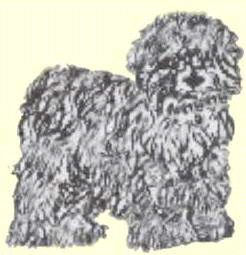
generally
square
outline,
carrying
a
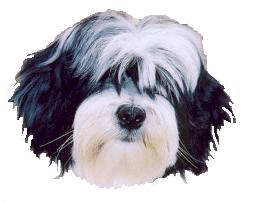
beautiful
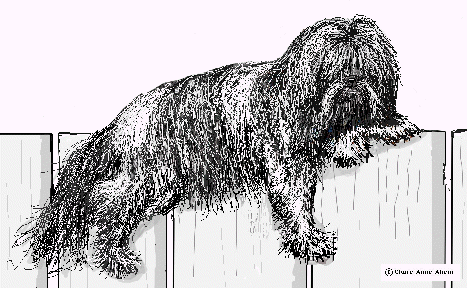
long
double
coat,
which
comes in
a wide
range of
colours.
Any
colour
(or
combination
of
colours)
including
white,
but
excluding
chocolate,
is
acceptable
in this
breed.
The
double
coat
protects
the
entire
dog,
even
falling
in front
of the
dark,
widely
spaced
eyes.
The fine
outer
coat can
be
straight
or wavy.
The
undercoat
is soft
and
woolly.
The coat
should
be long,
but
should
not
touch
the
ground.
The
Tibetan
Terrier
does not
shed
seasonally,
but the
female
is
likely
to drop
some
hair if
kept in
full
coat,
especially
after
having
puppies.
If you
intend
showing
your TT
you
should
never
use a
scissors
on him.
See the
American
Kennel
Club
breed
standard.
This
point is
echoed
in
detail
in the
illustrated
Standard
of the
Tibetan
Terrier
published
by the
Tibetan
Terrier
Association
in 1995,
Page 43,
first
paragraph.
Some pet
owners
like to
keep
their
companions
in a
'puppy
cut',
and a
good
groomer
will be
only too
happy to
show
pictures
of the
various
cuts,
and then
groom to
your
specification.
The tail
of
medium
length
is
heavily
furnished,
set
fairly
high and
carried
in a gay
curl
over the
back.
The
heavily
feathered
ears
hang
pendant,
falling
not too
close to
the
head.
The nose
and eye
rims are
black.
The
lower
jaw is
slightly
bearded.
The
desirable
mouth is
a tight
scissor
bite,
but a
tight
reverse
scissor
bite
(the
inner
surface
of the
lower
teeth
touches
the
outer
surface
of the
upper
teeth)
is also
acceptable.
The top
line is
level.
This
breed’s
unique
large
flat
feet,
well
furnished
with
hair,
produce
a
snowshoe
effect
that
provides
traction
and
flotation
in snow.
The
Tibetan
Terrier
has
great
agility
as well
as
endurance.
They are
lively,
intelligent
and
extremely
loyal to
their
family,
full of
character
and
personality,
and a
devilish
twinkle
in their
eye.
Height: 14 - 16 inches 36 - 41 cm
Weight: 20 to 24 lbs
Size: Small to medium
Showing:
Irish
Kennel
Club and
English
Kennel
Club -
UTILITY
Group.
They originate from Tibet; "The Land of Snow", the majority of the area being 18,000 feet above sea level, containing the world’s highest mountains. People and animals alike, constantly battle against the elements; snow, severe frost, floods, dust storms, and arid conditions. The long coat and the unique large round flat foot play their part in helping this breed to survive such harsh conditions. Originally raised by the Tibetan monks in monasteries, this breed was highly thought of by the Tibetan people, and is an ancient contributor to many other Tibetan breeds. The breed was considered to be "lucky" and dogs were often given as gifts, but never sold.
They were introduced to England in 1926, by a female surgeon, Dr. A.R.H. Greig, who had been working in India. She was given several dogs, the first by a grateful patient, and then by the Dalai Lama himself. Her dedication to these dogs resulted in recognition by the Indian Kennel Club (1930) and the English Kennel Club (1931). The majority of the Tibetan Terriers we see today originate from the stock belonging to Dr. Greig and her mother, using the Lamleh and Ladkok affixes.
NOTES
The long coat needs a lot of attention; so many owners who are not showing their dogs clip them, especially in summer. Bathe every 7 - 14 days. They can be flea sensitive. Brush every 2 - 3 days with a straight pin brush (not one with bobbles). Never brush a dry coat. Always mist with conditioner and water to ease brushing. Novice owners should be ready for the responsibility of grooming a coated breed! Since he is such a light shedder, the Tibetan Terrier is one of the better breeds for allergy sufferers. The Tibetan Terrier is a particularly good watchdog. Don't be fooled by the hair over the eyes; they never miss a trick.
They are a very healthy breed and can live to 15 + years. Breed followers recognise the existence of two eye conditions known to be inherited, Primary Lens Luxation and Generalised Progressive Retinal Atrophy. The breed can also suffer from Hip Dysplasia a deformation of the hip socket. The incidence of these conditions can be reduced by all stock being examined for eye and hip status, before being used in a breeding programme. Testing can only be undertaken with dogs over twelve months of age. For those interested in breeding click HERE for an article on the downside of inbreeding.
These days, there are Tibetan Terriers throughout the world. In England, since 1992, there have been over 800 new dogs registered each year. Indeed in 2004 registrations were 1,304. Ireland has only now started to publish registrations, but the number of Tibetan Terriers registered here would be significantly smaller.
PERSONALITY
Sweet, gentle and loving. Lively and fun. Can be wilful, which is only to be expected from the breed that invented creative disobedience. Tibetan Terriers are devoted to the family, but sometimes wary of strangers. Some are good guard dogs, and take the order to mind the house very seriously. When told to do so, my Molly takes up position on top of a comfy armchair in the front window, as her predecessors did before her.
They offer loyalty and companionship. They enjoy being around people, and are a fun breed. They are as happy loafing on the couch as they are hill-walking, so long as they are with their beloved people.
CHILDREN:
Good
natured.
Best
with
older,
considerate
children.
Perhaps
you
would
enjoy
reading
some
little
verses
relating
to
puppies;
if so
please
click
here.
FRIENDLINESS:
Extremely
loving
and
loyal to
the
family.
Can
sometimes
be a
little
reserved
with
strangers.
TRAINABILITY:
Slightly
difficult
to
train.
Responds
to
firmness
tempered
with
kindness.
Bullying
will get
you
nowhere,
but they
do love
to
please,
and can
usually
turn a
training
exercise
into fun
a games.
Click
here
to find
out
about
housebreaking
your
puppy.
INDEPENDENCE:
Moderately
dependent
on
people.
DOMINANCE:
Low.
OTHER
PETS:
Good
with
other
pets if
raised
with
them
from
puppy
hood.
GROOMING:
Frequent
and
regular
grooming
needed.
Click
here
for
further
information
about
grooming
your
Tibetan
Terriers.
COAT:
Long
coat
double
coat,
keeping
them
warm in
winter,
and
comfortable
in
summer.
TRIMMING
&
STRIPPING:
No
trimming
or
stripping
needed
particularly
if you
want to
show.
SHEDDING:
Very
light.
EXERCISE:
Moderate
exercise
needed.
JOGGING:
A pretty
good
jogging
companion,
and if
you like
hill
walking,
they
will
fall in
with
that.
INDOORS:
Relatively
inactive
indoors,
they
love the
comfort
of your
sofa.
APARTMENTS:
Will be
OK in an
apartment
if
sufficiently
exercised.
OUTDOOR
SPACE:
A small
yard is
sufficient.
CLIMATE:
Does
well in
most
climates.
OWNER:
Good for
novice
owners,
but I
think
you
definitely
need a
sense of
humour.
Have you
got a
sense of
humour?
Find out
when you
try this
link
Sherpaboy.
LONGEVITY:
Moderately
long
lived
(12 to
15
years).
TALENTS:
Loving
Companion,
Good
Listener,
Likes to
help
with the
Gardening,
Watchdog,
Agility,
and
Competitive
Obedience.